IN THE NEWS
Thoughts on The Law
Deepfakes Are Already in Court. Louisiana Has Rules. The Feds Are Still in a Meeting.
A judge threw out a whole case over a deepfake witness video. Louisiana now puts the duty on lawyers to verify evidence is real. The feds are still holding meetings. My take on AI evidence in court, and what it means if you’ve been hurt.
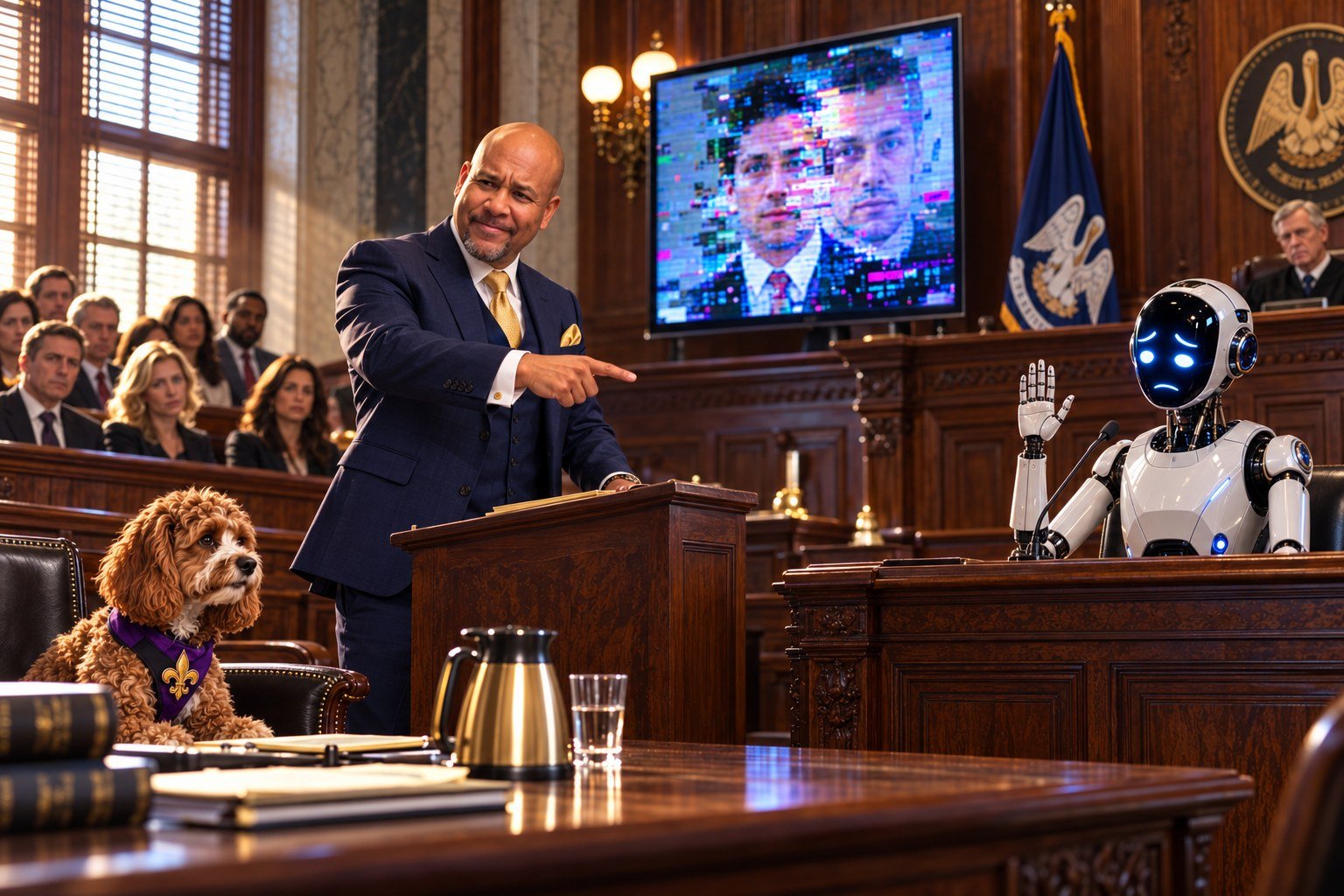
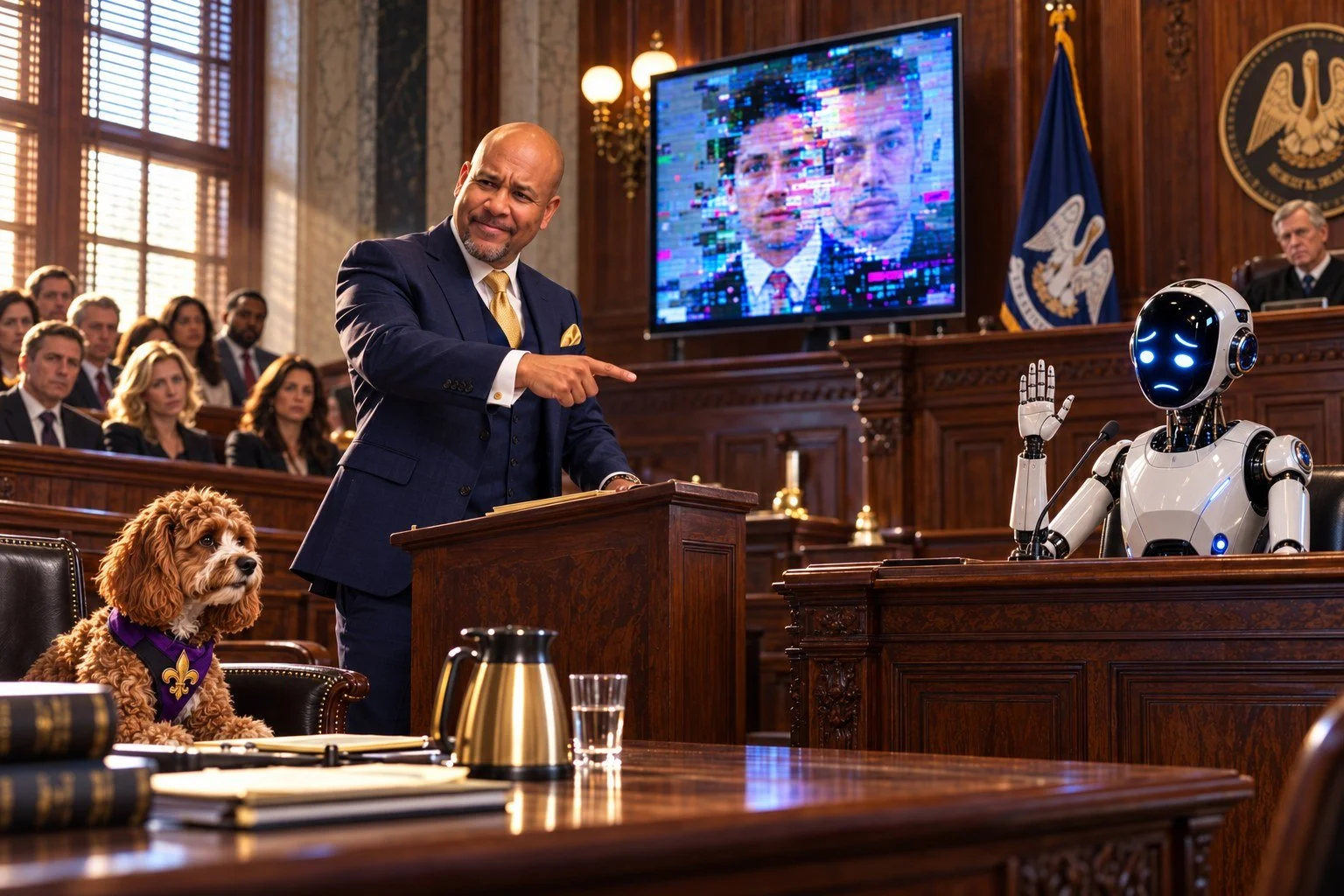
Illustration created with AI. Not a real courtroom, not a real case, and no robot has been sworn in. Yet.
THE HUMAN VERSION
Before we start: this is commentary and opinion, not legal advice. Reading it doesn't make me your lawyer. Neither does commenting, sharing, sending a DM, or asking a chatbot to "read this lawyer's blog and tell me if I have a case." Especially that last one. Every case turns on its own facts. Attorney advertising. And since it's on topic: I used AI to help write this. I also read every word and checked every case. Hold that thought.
First, a disclosure: I'm pro-AI. This firm has used AI since late 2022 for research, drafting, and keeping our notes straight. It's not a secret. So this is not a "robots are bad" post. This is a "robots are not witnesses" post.
The problem, in one paragraph. For about 150 years, a photo was proof. Now anybody with a phone can make a video of you saying things you never said, in your voice, in less time than it takes to get a po-boy at lunch rush. Courts run on evidence. Evidence just got a lot easier to fake.
And it's already happening. Three cases worth knowing:
California, 2025. In Mendones v. Cushman & Wakefield, the plaintiffs submitted video "testimony" from a witness. The judge compared it to a real recording of the same woman and noticed the voice, the rhythm, the word choice, and the facial expressions were all off. It was AI. The judge didn't just toss the video. She tossed the entire case. (The plaintiffs represented themselves, so no lawyers were involved. Don't worry, we're up next.)
Washington, 2024. In State v. Puloka, a murder case, the defense offered a bystander's phone video "enhanced" with AI to look sharper. The judge kept it out. AI enhancement doesn't reveal what's in the picture. It guesses what should be there and fills it in. That's not evidence. That's fan fiction with pixels.
The Fifth Circuit, February 2026. That's the federal appeals court over Louisiana. In Fletcher v. Experian, a lawyer filed a brief that AI had drafted, complete with quotes that didn't exist and law that wasn't the law. When the court asked about it, the court found the answers evasive and misleading. Result: a $2,500 sanction and a published opinion. The fine stings. The opinion with your name on it stings forever.
Louisiana didn't wait. Write that down; it doesn't happen often. Act 250 of 2025 took effect August 1, 2025. Louisiana Code of Civil Procedure Article 371 now says a lawyer must use "reasonable diligence to verify the authenticity of evidence" before offering it to the court. If a lawyer knew, or should have known, that evidence was fake or manipulated and offers it anyway without saying so, that's a violation, with contempt and discipline on the table. And in civil cases, if you suspect the other side's exhibit was made or altered by AI, the law expects you to raise it before trial, at the pretrial conference or an admissibility hearing, instead of springing it on the jury.
The feds, meanwhile, are still in a meeting. Literally. A proposed Federal Rule of Evidence 707 would make machine-generated evidence meet the same reliability standard as expert testimony. It went out for public comment in August 2025. In May 2026, the federal rules committee decided not to move it forward yet and to hold a conference of experts first. That conference is October 15, in Boston. A separate deepfake rule is drafted and sitting on the shelf. By the committee's own timeline, the earliest anything goes back out for public comment is August 2027, and federal rules usually take a couple more years after that. So if a deepfake walks into federal court in New Orleans next month, the judge works with the rules we already have.
Part of the reason for the caution: in a Federal Judicial Center survey, only 15 of more than 930 federal trial judges who responded had ever dealt with a deepfake challenge. That's either very reassuring, or it means the good ones haven't been caught yet. I know which one I'd bet on.
My take, in three parts.
Louisiana got the important part right: the duty is on the lawyer. We're the ones who sign the pleadings. "My client sent it to me" was never a great excuse. In Louisiana, it's no longer a legal one.
The bigger danger isn't fake evidence getting in. It's real evidence getting kicked out. Law professors call it the "liar's dividend": once everybody knows fakes exist, anybody can call real evidence fake. Picture this. You've got clean dashcam video of their driver blowing the light at Claiborne and Canal. The insurance company watches it, shrugs, and says, "How do we know that's real?" That's the fight I expect to see a lot more of. Whoever yells "deepfake" should have to show something more than vibes. The federal draft deepfake rule does exactly that: the challenger has to bring real evidence of fabrication before the burden shifts. I like that part. I'd like it more if it existed.
AI is a great tool for lawyers and a terrible witness. Use it to research, organize, and draft. Check its work like a first-year associate's on their first day. And never, ever let it touch the evidence.
If you've been hurt, here's what this means for you.
Keep the originals. The original photo or video file, on the original phone. Don't screenshot it, crop it, filter it, or "clean it up." Back it up exactly as it is. The data hidden inside that file (when and where it was taken) can matter as much as the picture.
Don't "fix" your evidence with AI. Not even to make it clearer. A blurry real photo beats a sharp fake one every single time.
Be careful what you tell a chatbot about your case. In February 2026, a federal judge in New York ruled in United States v. Heppner that documents a criminal defendant made with a public AI tool were not protected by attorney-client privilege. Other courts have seen it differently, and the law is still sorting itself out. Don't be the test case. A chatbot is not your lawyer. Tell your lawyer.
Save the boring stuff. Texts, timestamps, receipts, names of who was there. Real evidence is detailed and boring. That's what makes it believable.
Don't wait. Louisiana deadlines are short, and evidence disappears faster than you think.
My take, in one line: AI belongs in the law office. It doesn't belong in the witness box.
They say no. WE say OUI (684). Even when "they" is a deepfake.
Hurt in New Orleans or anywhere in Louisiana? Call (504) 684-4444. The consultation is free, you talk to the attorney, and there's no fee unless we win. Se habla español. We use AI every day. We just don't let it testify.
Cases and rules mentioned: Mendones v. Cushman & Wakefield, Inc. (Cal. Super. Ct., Alameda Cnty., Sept. 9, 2025); State v. Puloka (Wash. Super. Ct., King Cnty., 2024); Fletcher v. Experian Information Solutions, Inc., No. 25-20086 (5th Cir. Feb. 18, 2026); United States v. Heppner, No. 25-cr-503 (S.D.N.Y. Feb. 17, 2026); La. Acts 2025, No. 250 (La. C.C.P. arts. 371, 1551); proposed Fed. R. Evid. 707; Advisory Committee on Evidence Rules meeting notice, Federal Register (Oct. 15, 2026, Boston).
THE LAWYER VERSION
Attorney advertising. This post is legal information, commentary, and opinion, not legal advice, and reading it does not create an attorney-client relationship. Case, statute, and rule descriptions are simplified summaries drawn from published court decisions, the Louisiana Code of Civil Procedure, Federal Register notices, federal rules-committee materials, and public reporting as of October 8, 2026, and reflect the law on that date; the law can change. Every case turns on its own facts. "No fee unless we win" refers only to attorney's fees; clients may be responsible for case costs. This post was drafted with the help of AI tools and reviewed by a licensed attorney. The illustration was created with AI; it is a dramatization, does not depict actual events, a real proceeding, or actual clients, and everyone in it other than Oliver Hadley and his dog Bess is fictional. Responsible attorney: Oliver B. Hadley, Oliver Hadley Law, LLC, 700 Camp St., New Orleans, LA 70130.