
IN THE NEWS
Thoughts on The Law
Louisiana Changed the Election Rules Again. Here’s Your Cheat Sheet Before Nov. 3.
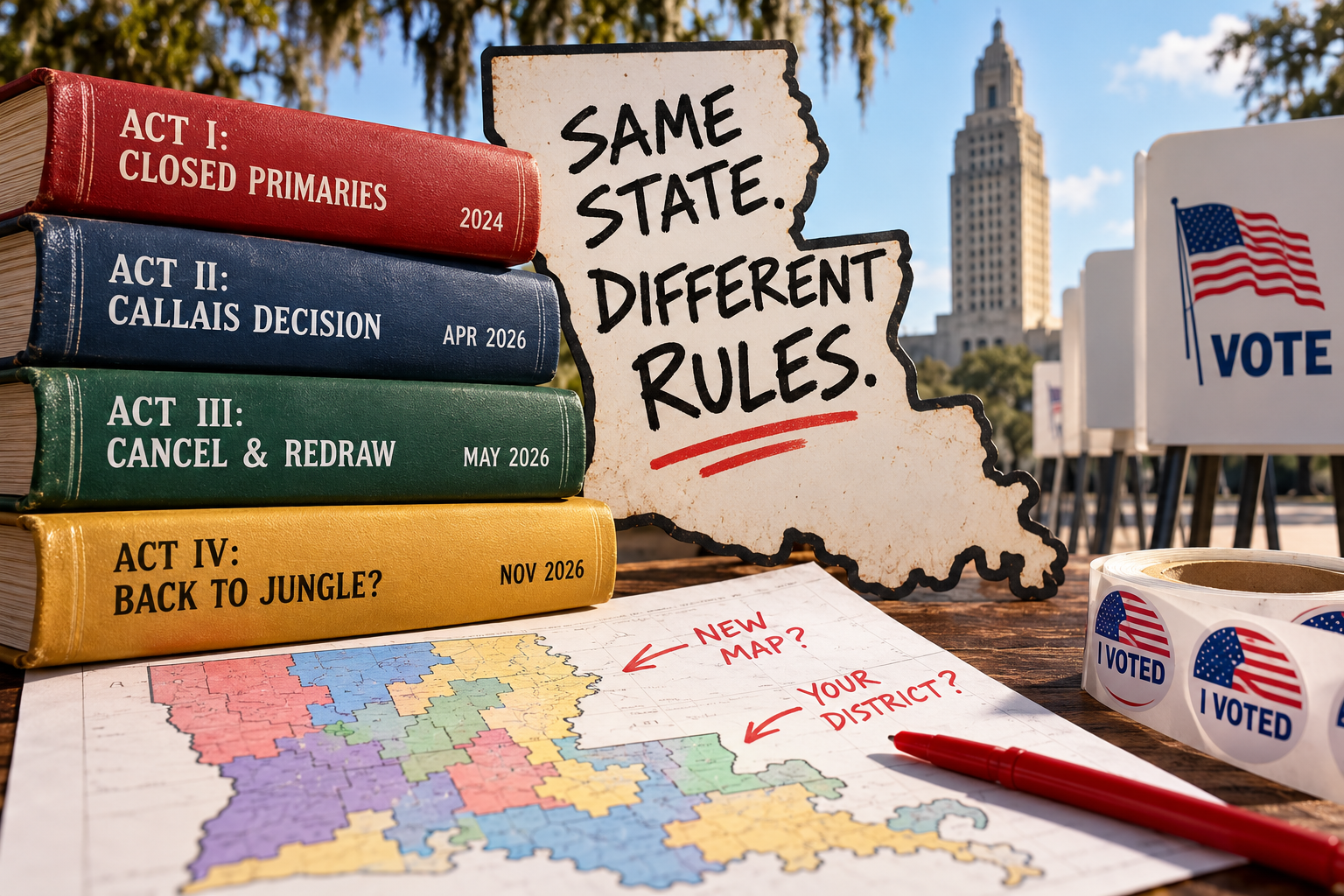
Closed primaries, a Supreme Court ruling, a cancelled election, and a brand-new map. Louisiana changed the election rules three times this year. Here’s what happened, in order, and what it means for your ballot on November 3.
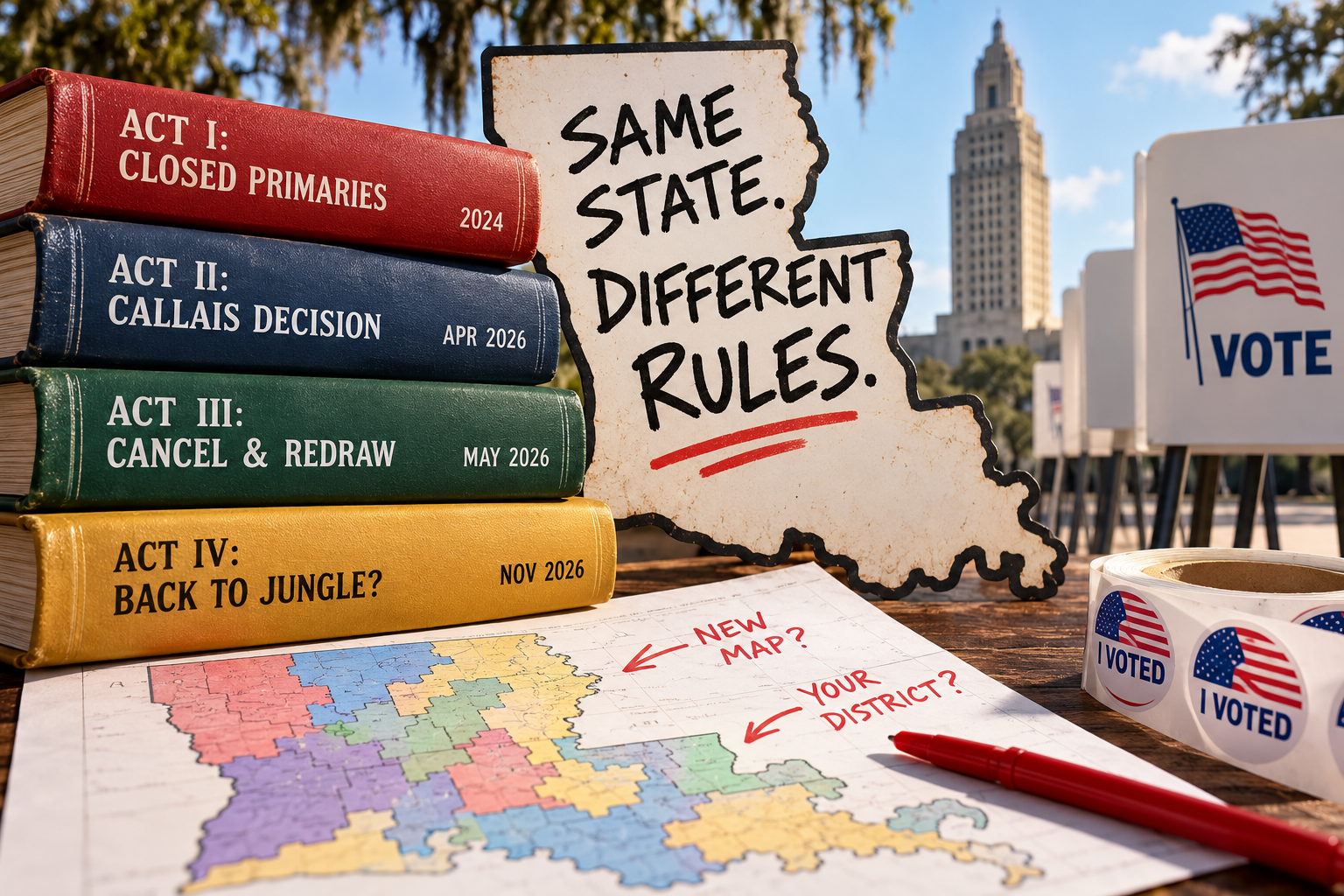
Illustration created with AI. The books are fake. The rule changes are real.
Before we start: this is commentary and opinion, not legal advice. Reading it doesn't make me your lawyer. Neither does voting, not voting, or arguing about this at a crawfish boil. Every case turns on its own facts. Attorney advertising.
If you feel like Louisiana's election rules changed three times this year, that's because they did. Here's what happened, in order, with only a moderate amount of eye-rolling.
Act I: The Closed Primary Arrives
For about fifty years, Louisiana ran the "jungle primary." Everybody runs, everybody votes, and the top finishers sort it out. In a 2024 special session, the Legislature passed Act 1, which created closed party primaries starting in 2026 for U.S. Senate, U.S. House, the Louisiana Supreme Court, and the Public Service Commission. BESE joins in 2027.
Closed primaries mean Republicans vote in the Republican primary and Democrats vote in the Democratic primary. Voters registered "No Party" pick one party's primary per cycle. Green, Libertarian, and other-party voters sit those races out.
Bonus plot twist: the Louisiana "Independent Party" was dissolved. If you registered "Independent" because you thought it meant "unaffiliated," you were actually in a party. Surprise. You're now "No Party."
The Secretary of State's office estimated the switch would add $54 million in election costs over ten years. Democracy isn't cheap. Apparently, neither is changing it.
Act II: The Supreme Court Throws the Map Out
On April 29, 2026, the U.S. Supreme Court decided Louisiana v. Callais, 6-3. The Court held that Louisiana's map, which drew a second majority-Black congressional district, was an unconstitutional racial gerrymander. It did not strike down Section 2 of the Voting Rights Act. It did add new hurdles for vote-dilution claims.
The majority's view: the Constitution forbids race from predominating in how districts are drawn, and the VRA didn't require that second district. The dissent's view: the decision guts the last major enforcement tool of the Voting Rights Act. Reasonable people are still yelling about it on both sides, and you can read the opinions and pick your corner.
Act III: Cancel the Election You Already Started
By then, the May 16 closed primary was underway. The Governor postponed the U.S. House primaries so the Legislature could draw a new map. Roughly 40,000 House votes already cast were tossed. If you voted early in a House primary this spring, congratulations. You participated in a very expensive rehearsal.
The Legislature passed a new map (SB 121) on May 29. It eliminates one of the state's two majority-Black districts, and it's already being challenged in court. Then lawmakers passed HB 842, which moved this year's U.S. House races out of the closed primary entirely and back to the jungle-style, all-candidates ballot on November 3.
So, to recap: Louisiana switched to closed primaries for Congress, used them once, partially, then cancelled them for the House and went back to the old system. Some legislative leaders have already said they expect to undo closed primaries after this cycle. Somewhere, a poll worker is laminating instructions for a fourth system.
What This Means for You on November 3
Your congressional district may have changed. Don't assume. Look it up.
Your House race is an open, all-candidates ballot this time. If nobody gets a majority, expect a runoff.
Pull your sample ballot from the Secretary of State's Geaux Vote site before you go. Five minutes now saves you twenty minutes of confusion in the booth.
If your registration still says something you don't recognize, check it.
My Take
Whatever you think of closed primaries or the Callais decision, voters deserve rules that hold still long enough to learn them. Changing the game mid-season isn't a partisan problem. It's a trust problem. When people show up confused, some of them stop showing up at all.
Know before you geaux.
— Oli
Disclaimer: This post is attorney advertising and general commentary on matters of public interest. It is not legal advice, and reading it does not create an attorney-client relationship. Election rules, deadlines, and district lines change; confirm current information with the Louisiana Secretary of State or your parish Registrar of Voters. Every legal matter depends on its own facts, and past results do not guarantee future outcomes. Responsible attorney: Oliver Benford Hadley. Oliver Hadley Law, LLC · 700 Camp St., New Orleans, LA 70130 · (504) 684-4444 · obh.legal