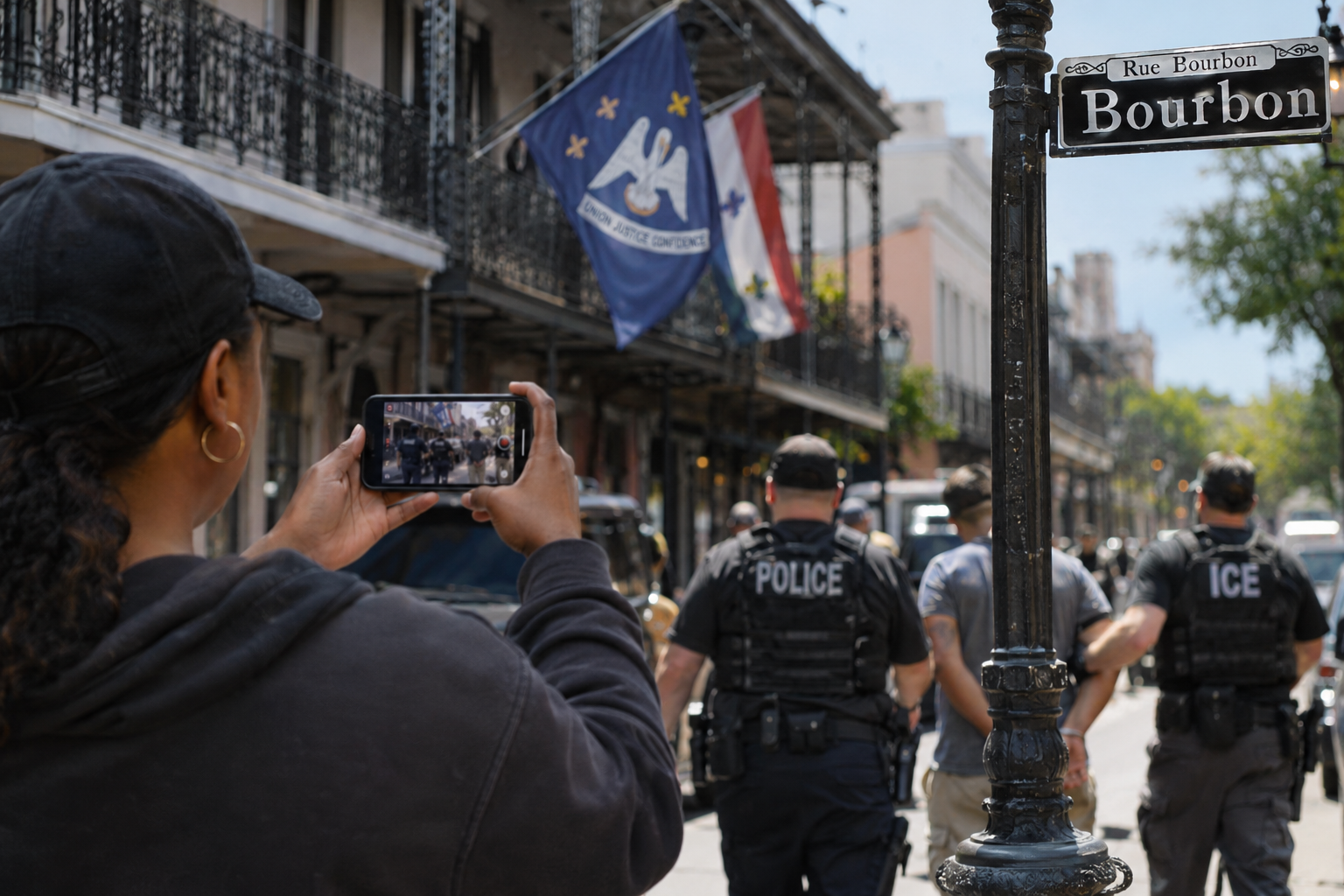
Illustration created with AI. Not a real arrest and not real people. The right to film is real.
Before we start: this is commentary and opinion, not legal advice. Reading it doesn't make me your lawyer. Neither does sharing it, livestreaming it, or waving your phone at me from 25 feet away. Every case turns on its own facts. Attorney advertising.
Last December, Border Patrol rolled into New Orleans with an operation named after our state dog. Since "Catahoula Crunch," a lot of folks in this city have found themselves on a sidewalk, phone in hand, watching federal agents make an arrest and wondering what they're allowed to do.
Short answer: more than some agents will tell you, and a lot less than your group chat thinks.
I'm a former public defender, and my old bosses had a saying they repeated until it stuck: you might beat the charge, but you're never gonna beat the ride. Hold that thought. It's the whole post.
Yes, You Can Film
In 2017, the Fifth Circuit (the federal appeals court over Louisiana, Texas, and Mississippi) held in Turner v. Driver that the First Amendment protects your right to record the police, subject to reasonable time, place, and manner limits. That covers local cops, deputies, troopers, and federal agents, ICE and Border Patrol included. If they're working in public and you're standing somewhere you're allowed to be, you can point a camera at them. No press pass required. No permission required. You don't have to know the person being arrested.
A few places the rule bends:
Private property, where the owner sets the rules.
Inside courthouses and many government buildings. Put the phone away.
Behind the wheel. Filming while driving is a ticket at best and a wreck at worst.
No, You Can't Interfere
The right to record is a right to watch, not a right to participate.
Federal law makes it a crime to forcibly assault, resist, oppose, impede, intimidate, or interfere with a federal officer on the job (18 U.S.C. § 111). Louisiana added its own felony in 2025 (Act 399) for acts meant to interfere with federal immigration enforcement. When the ACLU sued over it, the Attorney General's office told the federal court the law reaches physical obstruction, not speech.
Translation: holding a phone is fine. Stepping between an agent and the person he's arresting is not. Neither is grabbing an arm, blocking a vehicle, or "accidentally" standing in a doorway. And following agents around in your car is a great way to get stopped for "impeding," whether or not that charge ever sticks. See: the ride.
How Close Is Too Close? Even the Judges Can't Agree.
In 2024, Louisiana passed Act 259, making it a crime to come within 25 feet of a police officer after being ordered to stop or back up. In January 2025, a federal judge in Baton Rouge blocked it as unconstitutionally vague, because it gave officers no standard for when they could order you back. The state appealed. The Fifth Circuit heard arguments in June, and the panel sounded split. One judge asked, more or less, why anybody has a right to be within 25 feet of an officer in the first place. As I write this, there's no ruling.
Indiana has a similar law. In May 2025, the Seventh Circuit upheld it against a First Amendment challenge. Three months later, in a different case, the same court upheld an order blocking it as too vague. Same 25 feet, two answers.
Meanwhile, back on the street, agents in Gretna told someone filming an arrest to back up to 25 feet, citing the Louisiana law a federal judge had already blocked.
So here's my advice: don't go looking for the line. Stand well back. Across the street is great. Your phone has a zoom; use it. And if you're told to back up, back up, even if you think the order is garbage. Keep filming while you walk. If the order was unlawful, that's a fight for a courtroom later, not the sidewalk now.
My Three Steps: Comply. Record. Report.
1. Comply.
If you're told to move, move. If you're told to show your hands, show your hands. If Louisiana police lawfully detain you, give your name. Refusing to identify yourself, or giving a fake name, can be charged as resisting an officer under La. R.S. 14:108.
Complying doesn't mean surrendering your rights. You can say, calmly and once: "I don't consent to a search." "I'm going to remain silent." "I want a lawyer." Then let them do what they're going to do. Do not physically resist. Not even if you're right. Especially if you're right, because being right is what wins later, and a resisting charge only muddies it.
If you're not a U.S. citizen, your situation has extra wrinkles. Talk to an immigration attorney. That's not my lane, and I'll tell you so.
2. Record.
Start early and keep rolling. Say the date, time, and location out loud.
Get what you can: agency names, badge numbers, vehicle plates.
Hold it steady and horizontal. Narrate calmly or not at all. Your commentary is evidence too.
Back it up. Livestream or auto-upload to the cloud so the video survives even if the phone doesn't.
Don't unlock your phone for anybody. If they take it, don't wrestle over it. Police generally need a warrant to search what's on it.
Film the agent. Don't go digging up where he lives. Posting an officer's personal information to threaten or intimidate him is its own federal crime.
3. Report.
Write everything down while it's fresh: who, what, when, where, and the names and numbers of other witnesses.
If you're hurt, get medical care, and get it documented.
Save the video in more than one place.
File a complaint with the agency involved.
Then call a lawyer. Deadlines on these claims are real, and the clock starts the day it happens.
Fair warning on the federal side: the Supreme Court has sharply limited your ability to sue individual federal agents for constitutional violations. That doesn't mean there's nothing to do. It means the video matters even more.
My Take
The sidewalk is the worst courtroom in America. No judge, no rules of evidence, and the other side has handcuffs. You will not win your case there. You win it later, on video, on paper, in front of somebody in a robe.
The Constitution protects your camera. It does not protect you from turning a bad afternoon into a resisting charge. So stay back, stay calm, keep rolling, and let the footage do the talking.
Our slogan is "They say no, we say oui." When an officer tells you to back up, that's the one time I want you to say oui.
Comply. Record. Report. We'll deal with it after.
If an encounter with police or federal agents left you hurt, call us at (504) 684-4444. If you've been charged with a crime, get a criminal defense lawyer first. Se habla español.
— Oli
Disclaimer: This post is attorney advertising and general commentary on matters of public interest. It is not legal advice, and reading it does not create an attorney-client relationship. The laws and court cases discussed here are still developing and may change after publication. Every legal matter depends on its own facts, and past results do not guarantee future outcomes. This post was drafted with the help of AI tools and reviewed by a licensed attorney. The illustration was created with AI and does not depict actual events or real people. Responsible attorney: Oliver Benford Hadley. Oliver Hadley Law, LLC · 700 Camp St., New Orleans, LA 70130 · (504) 684-4444 · obh.legal
